








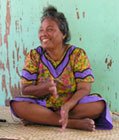
Interview of Chuji Chutaro
Life Story
Note: The interviewee is noted by initials, the interviewer by [Q].
Life During World War II
[CC] Well, there are a lot of stories about my life, but I think I will start from the time when I understood about my life. I was born in 1939 before WWII on my atoll Mili. I was raised there. Like you know of the Marshallese people, they usually concentrate on what we do in order to survive, like fishing, making breadfruit preserves [*], making dried pandanus preserves, digging up island arrowroot. All of these things I saw my mother and father and grandma and grandpa doing and I helped them.
But before the war began, WWII, in the Marshall Islands, I grew up and knew. I saw what happened in the war. Like, for example, Mili – the thing that I remember the most is when we constructed the airport for the Japanese military. I remember we used to work from morning until nightfall. Our group would work from morning to noon and from noon to evening and from evening all the way to midnight, and another group from midnight until daylight. Every day. Every day we worked. The kind of work we did was bring stone.
As for our children, they would weave baskets and we would use them to carry gravel and stone and bring them to the airport so that they could use it. As for the men and women their job was to mix cement. They mixed cement. There was no machine. You didn’t mix cement using an engine, but you mixed using your hands and constructing the airport. But like you know, when it is sunny no matter if it is really hot, we would still keep on working. If you didn’t work, the Japanese would cane you. This is how I saw it happen.
This is how we lived before the war began. And when the war began, there were a lot of problems. The problems were that the Japanese were taking everything from us, breadfruit, coconut, and pandanus and everything else. Before you climb a coconut tree or pick breadfruit, or picking pandanus, you had to ask for permission. If you did not ask for permission, they would take you and beat you up, if they did not beat you up, they would take you and put you in prison. And this cruelty was really scary.
I remember one of my grandfathers; he was picking breadfruit from his breadfruit tree. Because for us Marshallese, if you plant a tree, we say it is your tree and we say you can do whatever you want with it. So he went and picked breadfruit. As he was picking breadfruit, the highest commanding officer, the one who was in charge of our island. He came and took the old man and killed him. Killed him and hung him in one of the breadfruit trees. He tied him and his feet were higher and his head was lower, and the officer caned him. He was bleeding. Blood dripped from his nose, his ears, his mouth and from every orifice blood was coming out. After three days, they threatened us that whoever picked breadfruit or climbed a coconut tree without asking the permission of the commanding officer, they would kill. They called him, Taijo.
As I remember it, there were lots of problems. According to what my father explained, there were about ten thousand some Marshallese. The Marshallese came from this atoll [Majuro], Arno, and Mili. They brought them there so that they could work. Work for the Japanese. People from this island [Majuro] people from Arno, and people from Mili. They brought us there so that they could construct the airport and the harbor at Mili. Other than these Marshallese, there were forty thousand some, they say, “Jojeen.” Now we call them Korean. Forty eight thousand Korean laborers [in English] I am not including the one hundred thousand some soldiers.
Now that atoll could not take care of one hundred to two hundred some thousand people because when you add the Korean, Japanese and us, the Marshallese there were two hundred some thousand people. And we knew that the atoll could not provide for and support everyone if you are only going to eat local food. And there was no Japanese food or any other kind. They did not bring food from Japan because there was no way, because the American had bombed out all the ships that were going to bring food to Mili.
Now this means that we were famished, starving. There was no food. We only ate local food. But we knew that there was a season for breadfruit and the same goes for pandanus. It is not like you have both kinds of food at one time. Everything that moved, we ate. Let’s say, mice, lizards, and geckos. When you see a lizard or a gecko, you would find a way to catch it so that you can eat it. You cook it and eat it. I have eaten rat. It is so tasty, you see the furry ones, they are really tasty. Yeah.[Laughing]
Have you eaten the flying birds [not chicken]? The black ones? Well, that is how tasty the rats are. Well, that is how good the furry ones are after they are prepared. This is how to prepare rat: You bring one and kill it and then you put it in a pot and boil it. After boiling, you take it out and skin it. You skin it. And the only places where the skin would still be attached were the arms and legs. After that you gut it. And then you boil it again. Because when you skin it, you will see that the meat is still pink, but after you boil it a second time, it turns white. And when you are done boiling, you take it out and roast it over a fire. Geez, it is really tasty! [laughing]
When you see rats around, you would think they don’t taste good just to look at them. But when you are starving, you don’t think about it being a rat, but you think about how good it is because it tastes just like the flying birds. Everything that moved we ate. That is how hungry we were during those times.
Because the Americans were really smart, after the battle in Tarawa, Kiribiti, they did not come straight to Mili and destroy it, but they came to Majuro first. When they came here, there weren’t any people. There were only about ten or so Japanese on this atoll. They were guarding this atoll. And the place where they first lived, you see where MIHS [Marshall Islands High School] is located, well, their camp [the Americans] was first built there.
So they came here to this atoll [Majuro] and they constructed an airport. They built their own. It used to be [pointing to the atoll] here on this island. From Pacific Pure Water to Co-op school that was the airport. This is where the airport was located. This was the first airport that the navy constructed. So they built the airport so they could bring airplanes. They did not land, but they did fly over Mili every day. Morning, noon and evening: three times a day they came and bombed Mili. I believe that it was not only Mili that they bombed, but it was Maloelap, Jaluit, and Wotje. These were the atolls that they flew over and bombed without landing (unlike what they did in Kiribiti and Kwajalein).
But there was one thing that the Americans were really smart about, when they came to these islands and fought after they had fought in Tarawa, they realized that there was a lot of damage, because I heard that there were about eight or nine thousand Marines who were killed and wounded in the battle of Tarawa, Kiribiti. And maybe because there were many who were wounded from the battle in Kiribiti, because the Japanese really know how to make bunkers. And they would shoot at the Marines as they were coming onshore. And because so many of them were wounded in the battle in Tarawa, they really knew, they did not come onshore in Mili and the other atolls where there were Japanese, but instead, they came and built a camp here on Majuro, where there were no Japanese.
They built their camp here and they would fly sortees. And they did not only use bombs, but there were also another type of explosive that they used I saw how this bomb exploded, because when that device landed and exploded, it erupted in flames [incendiary bombs], and the flames burned everything. Everything: breadfruit trees, coconut trees and pandanus trees. Now, as they were burning breadfruit, coconut and pandanus, they [the trees] died. Now this means that we had a time of famine. That is the reason why we ran away . . . because we became very hungry.
We were not the only ones who were hungry, but the Japanese soldiers as well as the Korean workers who worked for the Japanese. If you were raised in those times, you would have witnessed what life was like in those times. It was really difficult. We became so hungry that we started to eat any plants we could find. I have eaten all the kinds of plants found here but they are not good for food. I will tell you this, just in case, in the future, there is a famine.
In the future if you ever encounter this problem. The type of plant that we mostly ate was markininjojo [beach pea vigna marina]. The leaves of the ironwood tree and the birds nest fern. You see the birds nest fern -- do you know what that is, the fern, birds nest fern. There is a thing inside fern -- it is a little curved -- well that part it is really tasty. It is like cabbage salad. But don’t you ever think of eating kiden [tree heliotrope] or konnat [a fleshy leaved shrub] because they are really bad. The kiden, no matter how many times you cook it, it always produces a mucusy substance. You could cook the leaves a hundred times and it still produces mucus.
As for the konnat, it is like mucus. As for the markininjojo [beach pea] it is really tasty. There are some leaves that are old and a little stringy, but the edible part is the leaves that are still young. Those are the type of leaves that you can boil and boil and boil until the water in the pot has turned green. Drain the water and add new water. Again boil it five or six times (even up to ten). Each time you boil it, drain the water and then refill the pot. Then when it is ready, look for fingerlings [finger sized fish] or clams. If there is no clam, look for eels. The ones you see swimming on the reef or in the lagoon. Overturn the rocks of the reef, and if you see an eel, you kill it and cut it up. Chop it into pieces and mix it with the markininjojo soup you have prepared.
Have you guys eaten the miso soup? The one that the Japanese prepare? The leaves of the markininjoj are like the leaves found in the miso soup that the Japanese make. And we felt much better when we ate markininjojo soup. But wow! When there were no more eels, then you look for another type of eel which lives in the deeper water. You guys know what this type of eel [maj-jijel] is? Have you seen the one that swims and is really scary? We brought it from the ocean and we cut it in pieces and mixed it with the beach pea to make soup. Well that was how stayed alive in those times.
Now, we come to the ironwood. The ironwood tree has two types of leaves. One looks really, really good –lively and green, and the other one looks swollen. The swollen leaf is the leaf that can be cooked and eaten. It also tastes good. As for the other leaf, which look lively, don’t even think about trying that one, it is not good, it is bad, it is not tasty. I have eaten every type of plant. The only ones that I did not like were kiden and konnat. Wow! They are really no good. The kiden will always be mucous-y forever. And the konnat, the smell of the plant will not go away. Well, this is the story that I know of during the war.
[CC] And now, we used to run away. And sometimes the Military boats would come near our islands. These boats belonged to the [U.S.] Navy, for they used to come near our islands and call ashore and say, “Are there any Marshallese on this island? Come here, we will shoot over your heads.” They said they would shoot above us, but we had to get on the boat. So we used to run away. As for the island where I was staying, every day an LCI [Landing craft] would come. We didn’t know what LCI meant, but that was what was written on the side. These were big vessels. When they came across our islands, they would call and they would use a loud speaker and they would say, “If there are Marshallese on this islands, come out because we will only shoot above you.” And they were speaking Marshallese. The Marshallese that were calling to shore were Jibilin and the guy Henry Muller and James Maddison and the other guys. The knew Marshallese.
They came and called to shore, and we would run toward the boat. We would get our clothes and our sleeping rolls we would carry it on our shoulders toward the boats, but we did not know that they did not need us to bring our mats. As we were about to get on the boat they would take the sleeping mats and throw them overboard. We were kind of sad because they threw away our sleeping mats, but they gave us sheets and a blanket and other things that we used to sleep on. And it was good because there was food. They knew that we needed rice. They would cook rice and bring it to us. And boy was it good! It was like being in paradise; that is how good the food was. You ate mashed potato, beef, and whatnot. Boy! The first day, I was aboard, as I was getting aboard, the sailors, they came to me and gave me chewing gum. I chewed and chewed and I swallowed it like I was eating it.
[Q] How old were you at that time?
[CC] I was five years old.
[Q] So they took you guys and where did you end up?
Life After the War
[CC] As for Mili, they separated us. One half of the Marshallese they took to Laura, the other half they took to Tutu, Arno. As for the group that I was with, we came from Mili. For that is where we came from. Half of Mili came to this island [Majuro] we went to Laura and that is where we lived. You see that place where the high school is located? That used to be the graveyard for the people of this atoll. They cleared the place and got rid of all the graves and bushes that were there and they built cloth houses ‘tents’.
Our very first night there, we all went and watched a movie. I had never seen a movie before, this was the very first time that I saw a movie. So, they constructed an outside theatre using big pieces of plywood and then they nailed white cloth to it for a screen. So we all went and watched. And the picture that we saw was a ‘Western Movie’ the type where the cowboys are chasing a train. So we all went and sat. I went and sat in the middle of the crowd and watched. Somewhere in the middle of the movie, the train was coming right at the screen, getting closer and faster, the people who were sitting in front stood up and ran [he laughs] [The audience laughs]
So we all stood up and started to run away and then they turned the movie off, the Navy stopped the movie because we thought the train was going to land on us, so we had to move. We said, “We really have to get out of here or we will get injured.” The next day, (the day after the first night there when we arrived on the boat and watched the movie) a guy they called Bob Hope came—an entertainer from America. Along with him came many women, and other entertainers, they were dancing and dancing and whatnot. And they created a stage next to where we were staying.
We all went and watched and the ladies. As they were playing, they wore the type of clothing they called ‘bikini’ -- they were really showing off to the Marshallese people. And the old guys were poking each other and my grandfather said, “How much do you think those ladies cost?” because the ladies were only wearing underwear that was really tight. My grandfather pinched me and said, “Go and talk to the soldiers ask them to sell us one of the American women.” and then he continued, “How much do you think they cost?” I said, “Goodness! I have no idea.” He kept on asking and asking. And you know what, at those times there were catalogs, Montgomery [Ward’s] catalog and Sears and some of these catalogs were brought here by the Navy, and the Navy would bring us some of the catalogs and we would look at the clothes that were in the catalog so that we could order.
My grandfather, he turned in his catalog, which was a Montgomery [Ward’s,] and he saw the women in the catalog and he said, “These ladies cost $39 for one.” I said, “Geez, it cannot be $39 for a lady! But he did not know that it was the clothes that they were advertising. He was thinking that the price was meant for the ladies in the catalog, and he said, “Wow, this is really good, I am going to fish.” He said he was going to fish so that he could come up with the cash to buy one of those women.
He did not come up with the money, but he really liked one of them [“pin-up girls”]. The name of that woman was Rita Hayward -- you see they named Rita [a village on Majuro] after this one. It came from one of these women. And Laura, was named for [another] one of the entertainers. Well, this is the story I know of during the war.
But it was really good because everything was cheap. When you went to buy candy, they sold it for fifty cents a pound. Which would mean that you would have one hundred some candies. But my grandfather did not stop -- he kept on asking me to ask the commanding officer about how much an American woman would cost. This guy [my grandfather] was really a bad guy [a rascal]!
But, you know, after the military was here, they built schools and there was a school that they built -- they called it the Atoll Education Program, and the guy, my grandfather, he was so sure of himself. When he would go to school, in the Atoll Education Program, this is how they would test the group of people who went to school: they would have everyone stand up. Standing inside the building, spelling [they had a spelling bee]. They tested spelling. They asked, “Can you spell ‘home’?” and one of them would spell home. “Spell ‘down.’” They spelled ‘down’. Can you spell ‘house’?” and that was how they did the spelling test. As they went on and on and on, many of them [the students] sat down because they misspelled something. And then they asked my grandfather, “Can you spell ‘beautiful’?” and he knew how to spell beautiful, so he got it right.
The kept on going and going and going, until it was only him, three men and two women. There were only six standing. And then they gave them a word. The teacher said, “Spell the word ‘geography’” The three guys got it wrong. And then it was his [my grandfather’s] turn. He said, “Hum, don’t you guys know that spelling this word is really baby chow?” You know, the reason why I say ‘baby chow’ is because the Navy used this word when it was time to eat. They said, “Baby chow.” [Easy]. And when he heard this phrase ‘baby chow’, he thought it was food for children…food for babies. ‘Baby Chow’ because ‘geography’ was an easy word.
He said, “That word is really easy.” But you know what? He was being a real show off to the old women, so that they would say, “Oh, that is the smart guy.” So he spelled geography. He said to the teacher, “Could you wait a little bit because I have to really think about the spelling of the word?” So he started to spell to himself. The teacher finally said, “Please go on and spell the word; we are getting tired of waiting, plus it is getting time.” He said, “This is the real spelling for the word geography, here it is: jiokraiokpa.” [The young people at this telling laughed]
[Q] Marshallese spelling, huh?
[CC] [To the young people present]. Well, that is the true spelling for the word geography. You know those guys, your teachers, they are not better than you, they don’t know.[Teasing] You have to learn from me, because this is the real spelling for the word.
At one time, the Navy came back to Mili (because every three months, they would come to our atoll [Mili]). They would come and do what they had to do there and everything. And they would also see the people there to check on them. So we all went to the beach, everyone from the children to the oldest, we all went to the beach. We went to the beach because we usually waited for the High Naval Officials. Well, the same old man, my grandfather, the show off. This guy was really a show-off, but he wasn’t shy. We all went to the beach and then the teachers (who knew how to speak English), they went to the ship.
So the people on the island said, “So who will be translating for us now that the teachers are not here?” Some of the old men there said, “What, you don’t see that guy over there who knows how to speak English?” And the guy [my grandfather] knew a little. But in truth, this guy was really, really bad [presumably his language ability]. So they asked him, “Can you translate for us?” He said, “Don’t worry I am the one who will translate.” All of a sudden, he was waiting for the small boat to come to shore, and as the small boat approached, the commanding officer (who came on the ship) was standing in front of the small boat, holding on to the line. The small boat came so far on shore that the bow was in the sand.
Just as the small boat landed, the commander jumped off. He sprang onto the beach. As he landed on the beach, the old guy [my grandfather] stepped forward to greet him. The commanding officer said, “How do you do?” And the other old men who were there asked, “What is he saying?” And my grandfather said, “This guy is saying, ‘How many coconut seedlings [‘iu’ ][which sounds like “you”] are on this island?’”
My grandfather thought that “How do you do?” really meant “How many coconut seedlings are on these islands?” Now he faced the commanding officer and started to count coconut seedlings with his fingers. And the other old men said, “Wow! Maybe a hundred thousand, if not a million.” He [grandfather] kept counting and counting until the American was tired of him.
The American said, “You son of a bitch!” The old Marshallese men asked again, “What is the guy saying?” and my grandfather turned to them and said, “All of you guys are bitches.” Then they got really mad. They said, “Boy, this American guy really has no manners! Is that how crazy he is? What kind of officer is this?”
[Q]How old were you when the war was over?
[CC] Ten.. I think I was ten, eight , five. Oh! I was nine years old.
[Q] Nine?
[CC] Yes.
[Q]And you stayed here on this atoll [Majuro]?
[CC] I was in Mili. We came to this atoll [Majuro] during ’45, then I returned to Mili in ’47. Two years.
[Q]So you were raised there?
[CC] I was raised there. Well, [addressing his audience] are you guys still sleepy and feeling hot? [No audible answer].
[Q] From the time when you were young, what changes have you seen?
[CC] What kinds of changes?
[Q]You know, those things that we are struggling with?
[CC] Well, life in those days was kind of good, especially after the war. It was really good because the cost of living was very low. One bag of rice -- [aside] there were no twenty pound bags of rice in those times -- one bag of rice, fifty pounds, cost only three dollars. Same goes for flour—a fifty pound sack of flour cost three dollars. Nowadays, the twenty pound bag of rice—what does it cost? Seven, eight dollars? Well, compare that to now. Not only that, but the cost for tuna was twenty five cents a can. Mackeral was the same. The only meat that was canned that was a little expensive was corned beef. It was fifty cents. Well, can you compare that to today; how much does a can of corned beef cost? There is a big difference. Well, that explains why the old guy, my grandfather, really wanted one of the American women that cost $39. There are a lot of changes, but the things I have seen that have really changed are the cost of living and the way of life. For in those days, we mostly depended on what we could produce from our own land: local food, for example.
As for clothing, I do not see the people using traditional dress [a softened pandanus mat tied around the waist]; but in the era before the war, I used to see people wearing these mats. One change I realized that was a drastic change was that in those days, we were careful to recognize our chief. For if the chief said something, we would do as he said. Nowadays, I see that people are getting smarter [about Democracy] and they don’t do what they had done before. And our chiefs in the past, when they saw us, no matter who we were, they would call us to come and eat with them, but the chiefs nowadays, when you see them eating in a restaurant, they will keep on eating without buying you anything to eat. But in those times, the chiefs would have bought you something to eat. If they saw you, they would buy you food.
Furthermore, if they saw you and you were hungry, they would give you food. But what they want [now] is for us to work for them and give them some part of everything we do. Well, these are the important changes. But when I look at it, we are still honoring our chief. But the chiefs don’t think about us, they think only of themselves and becoming wealthy. And these are some of the things that you young women and young men need to think about. What the chiefs want is for everything to be considered theirs -- wealth should be theirs. As for us, [non-nobles] we should keep ourselves busy by doing everything and submitting to them in everything that they do. Sometimes we hear their words, they say, “You have to vote this person into office,” and you will vote for that person because you are scared. Because the elders say, “You have to listen to the chief” (and we respect our elders). I think that it is getting better, but now our chiefs do not think about us. The only want us to work for them and submit to them. These are some of the things you all will need to think about.
[Q] When did you start working in the government?
Chuchi's Education and Role in the Marahsallese Government
[CC] I started working with the government when I was still a young man. After I graduated from High School, I returned to the RMI. When I came back, the Trust Territory Government hired me to work in the police station with the National Police. What I did was fill in their reports, and when there were cases, I helped them with those by taking them to the court. Usually these cases concerned scoundrels who stole things and created problems, and those kinds of people.
But after I came back from America, after I went to school, when I returned to the RMI, there were only three Marshallese with Bachelor’s degrees -- two had finished school before I did and then myself: just the three of us. But I think it was only I who went on to get a Master’s Degree. Because these two guys were working with the Government, they had no time to go back to school. I think if they had pursued their Master’s degrees, they would have succeeded. And maybe it might be showing off, my telling you this information, but I am just telling you what education was like in those times. This means that there were others who had gone to school, but they did not graduate. It is not because of any real problems, but because when we go to a place, we go there and hang out with the other students, especially the Marshallese students. When we get together, play around -- having picnics, and [being very sociable], we don’t think about studying.
But when I went to school, I did not go to Hawaii, I did not go to Guam. The reason that I did not go to these places was that I knew that there were Marshallese in those places [which would have distracted me]. I went to the US Mainland. The place that I went to was Ohio. That is where my wife comes from, and the reason I went to Ohio was because there were no Marshallese, no Micronesians in the middle of America. Because I knew that if there were Micronesians and Marshallese, I would have hung out with them and forgotten about my studies. I am not telling you this story because I am so sure of myself. I am telling you this story so that when some of you pursue higher education, you remember our problem in these atolls. We mostly think of going picnicking and talking stories with each other and wasting each other’s time, but we are not thinking of school, and the reason why there are problems for us Marshallese. And we don’t finish our school because of this.
And another reason, I don’t know what type of a sickness this is, but it is in our hearts, I don’t know where it comes from, but it is within us. For you know this, in those times there were a lot of young women, our women, they were still young ladies in those times when I was in school. We all went to school and you know what? When we came back, they came back with a degree, and do you know what kind of a degree they returned with? [they all were laughing] When they were getting off the airplane at the airport, the southern airport, when they came off the plane, they were leaning backward and there was a big ball that was leaning forward in their abdomen. Well, that is the kind of degree that they acquired. [laughing] Young ladies, I apologize for saying this, but I am telling you about these things that usually happen to Marshallese.
It might be a bad approach to tell you something you have heard before, you might say, “Oh, boy, this old man is really showing off!” But you see, when I came back, the High Commissioner, the guy who was looking over these islands in the time of the Trust Territories, the President of America appointed him to look over us and he [the High Commissioner] did that. And when I arrived in Majuro, he hired me to work with him and my job was here was in the Department of Community Development. I was the Director of that Department. He appointed me to be the Director as a Department head. You know the Department that they call IA? Internal Affairs? Well there was a branch of that office that was Community Development: this was the start of it here in these islands. I would be showing off, if I told you about some of the things that I created. Do you guys see the Alele Museum [the national, cultural museum, which stands nearby where he is talking]? That was the first project that I started here in this country. Alele Museum and Headstart. The Headstart program used to be called the “Skills Center.” And this program started in this country.
And the other program, the one that they call the “Grant in Aid” program. And I am not [even] telling you about how I worked and settled the problem for the people of Enewetak, Bikini, and those [who suffered from America’s nuclear bombing tests]-- because I worked with them as well. In fact, I spent half a year in Bikini investigating problems that they encountered. Who knows? Maybe I went in and out of the American Congress three, if not four, times in the name of the people who had radiation sickness.
[Aside]. The way I am telling you my story is not well-organized because I see that you guys are students and I am a Marshallese, and I want you to be successful when you pursue your education or your future. But the thing that is holding us Marshallese back [is another type of sickness] I don’t know what type of sickness it is. The kind of sickness that you all understand [not radiation]. As for us, the young men who went to school [high school], we went to school in Guam. Every evening, I would watch the guys sing [a well-known love song], “Honey, when you are thinking of me…”. They were singing the song, “Honey When You Are Thinking of Me.” And this was one of the problems. I don’t know. I don’t know. [Spoken in both Marshallese dialects]. I don’t know what type of sickness this is and why it is embedded within us.
[Q] When did you start running for Senator?
[CC] Before I …After, you know the time when the Trust Territory was starting to go back, the Government of the Trust Territory, America, they were going to leave these islands. I ran for the Congress of Micronesia, representing this island [Majuro], Arno, and Mili. And I was a Congressman for these islands in the Congress of Micronesia for a term, four years. And at the point we were going to separate from [the Federated States of] Micronesia, when our leaders hated [literally translated] the Micronesians. At that time, I came back and ran [as a Senatorial candidate to the RMI Government] from my island [Mili]. And for twelve years, I was in the Nitejela [RMI Parliament, House of Commons]. And you know what?
Everything that I am telling you, I did not achieve because I was knowledgeable -- knowledge does not belong to one person. Can you guys look back and see who created heaven and put it where it is? Do you guys know who did it? Well, maybe you know that God was the one who created and located the heavens… So to whom belongs the knowledge: is it yours? Is it your girlfriend’s or boyfriend’s? It is not your girlfriend’s or boyfriend's, but it is God’s. Well, remember this, for it is the key -- and I have experienced this in my life -- the reason why I am talking about this is because I experienced it. Everything that I could not do in my life, I would pray and ask for. Even though I had not converted yet, still I prayed and asked because I knew that God existed and I asked for help because I knew that He could help me in everything that I could not do. And I was successful in everything that I pursued. It is not because of anything but that I looked to Him first, and secondly, I was patient and strove for the goals that I thought right.
And you know what? You should wait to think about that sickness [having a family]. Is it not right that some of the people who went to school, when they come back, they come back with that type of degree [having a family]. As for the guys, when they arrived back here, they would bring back a gift. Their other hand would hold on to a child as they came off the plane. For the airplanes used to land -- you see where the new hospital is located? That is where the airplanes used to land. We would sit under the coconut trees watching people come off the plane. I am not telling you this because I am making fun of us [Marshallese]. But I am telling you this because I am advising you. So that when you pursue your education, first of all, pursue education. And everything else can wait. These are the things you will tire of. Just like now, as I grow up and become an old man, I am getting tired of them [my family] [all laugh].
[Q] Is there anything else you want to say to…
A Funny Story
[CC] All of this information that I’m telling you are like words of advice for you guys. I will tell you a really funny story. In the past, when the Marshallese, the Pohnpeian, and Kosraean people would go to Kwajalein and then we all would fly from Kwajalein to Hawaii. Isn’t it right that now you can fly to Hawaii from here [Majuro]? Well, in those days, you had to go to Kwajalein and get on the Military flights from Kwajalein to Hawaii. Also, when you came back, you came back to Kwajalein. And from Kwajalein to here. And the story I will tell is about when I was returning from school. I finished school and I was coming back from America. I arrived in Kwajalein, but I forgot my toothpaste. I left it in my hotel in Hawaii. So, I was looking for the American Ombi, the liaison officer for the Government of the Trust Territory on Kwajalein. I asked him if he could give me permission to buy [toothpaste] because in those times you had to ask permission to buy anything at Macy’s [the American store named after the famous one in the States] and the other military stores at Kwajalein. So, I went and asked if I could buy a tube of toothpaste because I had forgotten mine. He gave me permission to go to Macy’s to purchase some.
When I went to Macy’s there were two Marshallese women. These two ladies were maids for the American who were living in Kwajalein. So I went and sat beside them and they were not speaking Marshallese to each other, even though they were Marshallese. You know when they saw me they started speaking English. They were speaking in English to each other and their English was good. And then a guy, a classmate of mine from the Marshall Islands Intermediate School, (there were not high schools here in the time we went to school.) So this guy was leaving Macy’s with his bag. He brought a scent [perfume or cologne] and one of the women asked, “Hey, where did you buy that?” and he said, “In this store.” “What do you call it?” “Airplane, B-52.” He didn’t say hair oil. B-52 was the airplane that flew at the time, used for bombing. The guy was lying to the woman. She said, “What is it called, can you come here and tell me the name again?” He came back and told the woman, “The name of this perfume is ‘Airplane B-52’.”
All of a sudden, this guy says, “Hi” to me. I said, “Hi.” He said, “Where are you coming from?” I said, “I came from our island, I came from Mili.” “And when did you get here?” he asked. I said, “Do you see that ship—the one that is making the field trip [a supply circuit of the atolls] moored in the harbor? I came on it from Majuro.” And the woman really believed that I was coming from Majuro on the field trip. “Miletopi it is called.” [The Miletopi is now scrapped in the lagoon next to where Senator Chutaro is sitting] That ship that is ruined, that ship right there. Then the woman said [in English], “Well, I’m going.” The other asked, “Where are you going?” The first replied [still in English] “I go to store.” “What you gonna’ do?” “Buy B-52!” [the audience is laughing here].
And you know what? She left and I followed her. She went straight to the woman in the store. The woman in the store was an American clerk. I went in and I did not show myself, but I went to the men’s clothing section, pretending to be looking at the men’s clothing, but my ears were listening to what they were saying as I was flipping through the men’s clothing. I was listening to what they were saying.
And the Marshallese woman was getting angry with the American because the American did not know what “Airplane B-52” was. The Marshallese woman said, “Just give me all those airplanes.” The American woman said, “Sorry but we don’t carry [sell] airplanes in this store. This is not a place where you can buy airplanes. Plus the price for an airplane is one million some [dollars].”
They argued for a long time because the Marshallese woman was begging for the “Airplane B-52”. The American woman came out from behind the counter and took the Marshallese woman’s hand and said, “Come.” They went out the door and headed to the airport – from Macy’s you can clearly see the airport. So, I left the store and stood beside the building so that I could see where they went.They went across the baseball field near the outdoor movie theatre and headed to the airport. When I looked, the American was pointing to an airplane and I could see the Marshallese woman shaking her head. They came back to the store and entered. As they entered, I followed them in to see what they were doing. I was thinking of helping the Marshallese woman because she did not understand. Because I knew that the guy lied to her.
When I went into the store, they were arguing about the same thing. So I came up quietly behind the Marshallese woman and patted her back and said to her, “Excuse me, but what are you two arguing about?” She said [in Marshallese], “We are arguing because this woman is crazy. She can’t speak English.” I said, “How can that be?” She said, “She can’t speak English because what I need, she cannot give me because she does not know what I am saying.” I said, “Can I help you?” She said, “Do you know English?” “A little,” I said. She said, “Where did you learn to speak English?” I said, “In the midst of Mili. In the midst of the woods of Mili.”
Then she stepped away, but I stepped forward and tried to explain to the American woman. I explained and explained. And then she said, “Ohhh! So that is what that woman needs.” As she was saying that, she brought down the scent and gave it to the Marshallese woman who bought it. She bought it and went out the door. And the American woman said, “Boy, are you [Marshallese] mean!” “Why?” I asked. She said, “Well, that woman kept begging for me to give her an ‘Airplane B-52’ but we don’t carry any airplanes in this store.” [Directly to the audience] You guys, forgive me, the reason I am telling you this story is not to make fun of people, but I want to show you that sometimes in our lives, we think we know what we are saying, but we don’t really understand. For example, as you know our government is saying ‘People first’ but do they know what ‘People First’ means? And are they working to put people first? These are some things you guys need to think about because you will become young men and young women in the future. And you know, some of you guys may be Senators and Ministers in our Nitejela. I am telling you this information not because I want to say bad things about our government, but because now I hear that the people in our government are saying bad things about the earlier government--our leaders in the previous government who also did their best to find ways for the betterment of our island. I don’t know, maybe you guys were still young when I was Senator for my island for twelve years. Are there any more questions or thoughts? Is there anything you don’t like? Boy, [to the person asking questions] this is the only thing I do not want you to translate.
From 50:35 to 52:20 Chuji Chutaro asked that this part be removed from the study.
[Q]Can you tell us a little about how the Marshall Islands came to be?
[CC] What?
The Start of the Republic
[Q] How did the Marshall Islands develop?[CC] You guys excuse me but I don’t really know, but as I read books. According to the geologists and other people who know about how these lands came to be, they said that these islands were volcanic. And these islands were like mountains, they came up from underwater and when the volcano erupted, the lagoon formed, and then around the mountain was the land we see nowdays where the reefs were. This is how they say it happened. When the coral grew and became reefs , as you know the stone, the coral, the reefs, they grow.
[Crowd] Question!
[CC] Go ahead.
[Crowd] How did our government form?
[CC] the government of the Marshall Islands, right? Wow! That is a long story [In English]. There was an interesting one. That is a good question, but you know what? Our government was not an easy government to form. Because there were some who wanted to be wealthier than the rest of us. What they wanted was for the all of the wealth in the Marshall Islands to be in the palms of their hands. Do you guys know what this place was used for? This very ground where we are sitting?
[Q] Camp.
[CC]What was it?
[Q] The place they called a camp.
[CC] Well that is not it. This place where we are sitting used to be the Ministry of Public Works. This is where the Public Works used to be. Do you guys know where it is now located?
Q] Delap
[CC] Why? Why is Public Works now located in Delap? CMI, the place where you go to school. What was it before?
[Q] Hospital
[CC] Hospital. But now, where is our Hospital? Why? Can you guys think about why? What is the reason? Who wanted to be wealthy? Why were they moved from Uliga? Why did they move them from Uliga to Delap? What is the reason? Can you guys think about that? These are some things that are really deep and it is hard for us to understand, but like I have mentioned before, there were some who wanted to be wealthy, individually, but not as a group. Not for us, but for themselves. It is like, for example, this place used to be the Public Works, but they moved it to Delap. Why? Because as they were moving the equipment and such, the government leased the parcel of land for the new Public Works Ministry. To whom does the land [Delap] belong? Not the chief of Majuro. Our chief, the first President of the Marshall Islands [who is chief of part of Kwajelein Atoll, Delap, and part of Ebon Atoll]. That land belongs to him. Just after we succeeded from the Federated States of Micronesia, he immediately pulled all the Ministries from Uliga to Delap so that the RMI Government could lease the land from him.
Where is the Cabinet Building located, where is it now? The largest office for the RMI, where is it? It is in Delap. Where was it before? Do you know? You see the place called Division 7-12 owned by Grant Labon. That is where the office for the Trust Territory Government was located, but now the Government buildings are in Delap. Think about that one as well. But these things, like I said, well saying bad things about people, but our actions speak louder than our words.
I was old enough at that time, I was 30 years old, when we seceded from Micronesia. So, why did we secede from Micronesia, why didn’t we remain a part of America so that we could maintain our ties? Why did we secede and become independent? The reason is so that it would be easy for the leaders who wanted to separate from Micronesia to become wealthy. These are some reasons. This is what we were afraid of. We did not hate our leaders, we did not hate their thoughts, but we were afraid of their ideas. It was not just me, but Ekbab Silk, John Milne, and Mose Milne, and there were other old men who were with us, and our current President Litokwa Tomeing. We did not hate those people, our leaders, but we were afraid of what they were about to do.
Just like the Hospital, as you see it now. Just after we seceded from Micronesia, they took the Hospital to Delap, they took the Administration building (or Cabinet) to Delap, and they also took the Public Works to Delap. And do you see this house I am living in? This is where the Air Marshall Islands office used to be. Where is it now? Isn’t it in Delap? So these are some things for thought. We did not show any animosity to that group, but we showed them that we were afraid. Do you guys know where RRE used to be? Robert Reimer’s Enterprise? Now it is Formosa, the Marshallese company, not the American. Well, do you guys know where RRE was first located?
[Q] Delap.
[CC] Where in Delap?
[Q] NTA [National Telecommunications Agency]
[CC] It was just across [the street in the direction of the lagoon] from NTA near that Beauty Leaf [Lukwej] tree. When you go there, you can still see the cement slabs. Well, that was where RRE was located. And now, where is it?
[Q] Uliga.
[CC] It is located in the northern part of Uliga, why? Why? Because they [the chiefs] moved them [RRE]. The chiefs and the stewards sent Robert away from Delap because he had money and he was wealthy and they hated him because he was rich. You know…. And me as well, they also put me off their land as well. That is when I went to Demontown [a town in Rita, north of Uliga] and built there. And these are some problems. Why did our chief, our first President, hate Dwight Heine? For what? Because those three, [Kabua, Heine, and] Ekbab went to school in Hawaii, but they did not accept him [Kabua] at the University of Hawaii, even though they did accept Dwight Heine, and he went to school in the Main Campus in Honolulu: Manoa’a campus. But they sent Ekbab Silk to Hilo, a branch of the University of Hawaii at Hilo. And these two guys had degrees when they returned, but the President, our first President, our High Chief, was not successful. Do you know where they sent him? They sent him to Mauna Loa High School so that he could enroll there. He was not yet ready for college level work so they sent him to Mauna Loa High School.
If you go to Hawaii, there is a small city called Salt Lake City. It is located down [the mountain] from Tripler. Tripler is located up. Down and to the left is where this small city is located. Mauna Loa High School is located in Salt Lake City. Well, that is where our leader went to school. It is true, our leader graduated from High School, but he had no college degree. And that is the reason why he hated Dwight and Ekbab. When I came back with a degree, he also hated me because they say that people from Ebon, they are no good, they are bad, show-offs, and selfish.
This is where politics started here in the Marshalls, it started at this time. And I, and Ekbab and ‘Tokwa hated, no not hated, but we feared the separation. The reason why we were afraid was because we knew he would do what he wanted because he was a chief and held the respect of the people. When he said, “Secession,” we seceded. Why did we not secede from Micronesia to become a Commonwealth of America? (Because now the Marshallese are migrating to America so that they can live there.) Why didn’t we become a Commonwealth? Because he [the chief] hated it. Why did he hate it? Because if we were a Commonwealth, the leaders of the United States would have had control over the Marshall Islands and how we live, and control our rights, and those things.
But why are we semi-independent and not fully independent? So that he would have the power to control everything according to his own interests. As evidenced when he moved every Government Department to Delap. No one among us said anything because we couldn’t -- we were afraid. Do you know why Jerry Kramer is a millionaire today? Do you know the reason? Because they were partners. Do you know who owns PII [the business Kramer runs]? It still belongs to them. His name does not appear, but he has many front men. However, under the table, they would say, “Here is your cut for this month.” These were some of the problems and we were not very bright, we were foolish, since we saw what was planned and we knew that problems would occur, but we were afraid. We were not mean, but we were afraid.
What I am telling you may not be pleasant, and I am not pointing fingers at anyone. I am not saying bad things about our first President [Amata Kabua], but I am telling you what has taken place in these islands [this country] which you do not know about because you are still young. I will give you an example: one that I know well because I worked on it. In our Constitution, I sat with our leaders and we created our Constitution. There is a section in the Bill of Rights concerning this thing called ‘ethical government’ [in English] a law that has truth and right. The lawyer and I wrote down everything that a leader should not do. They should not have a business, they should not tell the voters how to vote, and other things. But when it was passed to the Presidential Committee, (and he was the chairman of the last committee that was responsible for revising the Constitution) and my committee was responsible for the Bill of Rights of the People. He might have wanted to remove the Bill of Rights from the Constitution, but the good thing was that the lawyer with whom I was working, he was our consultant, from Harvard University in Constitutional [Law].
And it was good because he advised the President that he should not remove the Bill of Rights because if he threw it away, it would be difficult for America to associate with us. And he [the President] was afraid of that because he knew that the lifeblood of our country [these islands] comes from America giving money to help us. It is not easy to secede; it is not easy to form a government. It is a humongous work. And we thank God because he directed our leaders to form a government, which gave rights to the people. As for me, there were some things that I was afraid of, and one of them being our chief, the President of our country: told me that what he wanted was that there should be only one chief in all of the Marshall Islands [there are about 10 chiefs in Majuro alone]. From your point of view, is it right that the Marshall Islands should have only one chief? The other chiefs, where would they go? What would become of them? In the time when I was a Congressmen and he [the President] was a Senator in the Congress of Micronesia. He came to me and took me [aside], and we sat for two days talking about his idea. What he wanted was for us to secede from Micronesia and form our own government, and his desire was that we should have only one chief-- not many chiefs [by tradition there are many chiefs]. Do you think this would have been acceptable to the other chiefs?
If you guys would….I see some of you guys three or four of you have already taken the course that I am teaching [Marshallese Government] one of the things that is discussed in that course is the House of Irooj [‘chiefs’—Equivalent to the House of Lords in the UK]. The reason why the House of Irooj was established was to buy the goodwill of the chiefs so that they would think they have a say, but in truth, they don’t have power. They can recommend policy but do not make the laws. They pass resolutions not bills [laws]. And the reason why he came up with this idea was to make the chiefs think they have a voice; having their House in the Nitejela blocks their eyes [from the truth]. I could talk to you all night about what is evident in the government, but we still would not have scratched the surface -- that is how deep and how many problems we have encountered, and I know that there will be problems in the future, and it is you guys, you are still young. You have to start thinking about our future. But I don’t know because the problems in our country nowadays, there are more and more beautiful women and handsome men and because there are more beautiful women and handsome men, that is a problem. And it is not getting better, but it is getting worse.
The section of the interview from 1:07:25 to 1:08:44 Chuji Chutaro does not want included in the study.
I apologize, but when you translate this information I am giving you. Please delete that part.